
Located at Wake Downtown, the Zeiss LSM 880 Confocal can be found in Room 2808

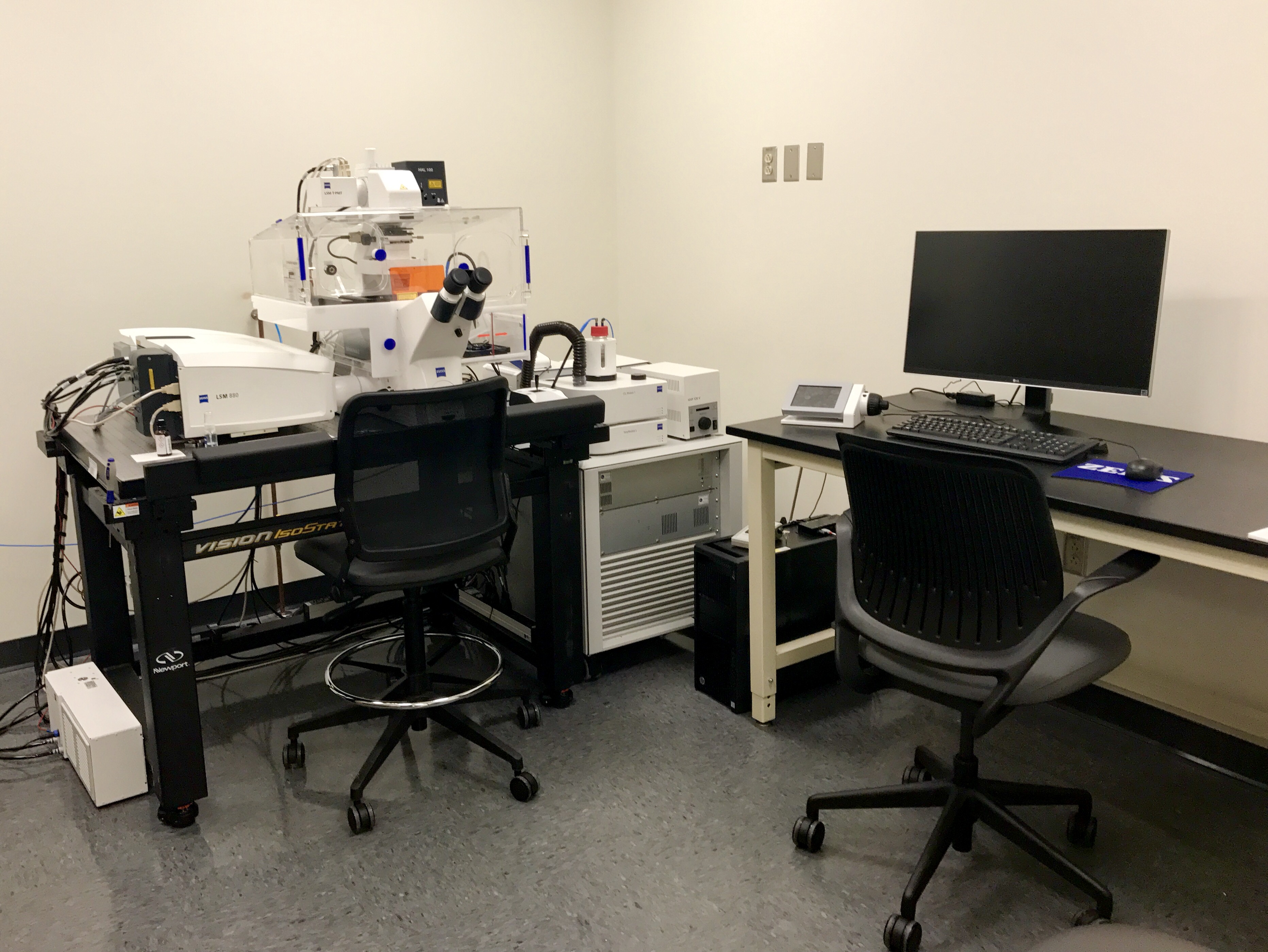
The Zeiss 880 confocal utilizes GaAsP detectors which are approximately two times more sensitive than detectors of the previous 700 series microscopes. This allows creation of high resolution and high contrast 3D images even in conditions of low fluorescent signal. The LSM 880 confocal microscope offers traditional multichannel, spectral imaging mode, as well as proprietary “Airyscan” modes. The Airyscan method spatially distributes emitted light across a hexagonal detector array, dissociating in focus and scattered light, and then performs several mathematical transformations on the image data to re-assign and restrict light output to properly focused regions. The resultant Airyscan processed image provides up to a 1.7X improvement in resolution beyond traditional image capture capabilities along with an 8X improvement in signal-to-noise ratio.
Fast, High Resolution Imaging– The LSM 880 is equipped with the Airyscan Fast module. This allows gentle imaging at 4x the normal LSM speed, with improved resolution and signal-to-noise ratio compared to resonant scanning systems. This feature is perfect for many applications that would normally require a spinning disc confocal microscope.
Base Microscope– The 880 confocal scan head is coupled to the AxioObserver Z1 inverted microscope. This inverted microscope platform provides versatility for live and fixed slide, well-plate, and dish imaging applications. The Z1 is a fully motorized microscope, allowing software control of objectives; fluorescent cubes; transmitted, epi-fluorescent, and laser illumination; Z-position, and X/Y on the stage.
Laser Lines– 405nm, 458nm, 488nm, 514nm, 561nm, 633nm
Accessories
The AxioObserver Z1 is equipped with three fluorescent filter cubes, Zeiss sets 49 (blue), 38 (green), and 63 (red) which allow viewing of your sample through the microscope. Full details about these Zeiss filter sets are available here. The microscope is outfitted with a range of dry and immersion objectives, all with high numerical apertures and specifically designed for confocal imaging.
| Objective | NA | Working Distance (mm) |
| Plan-Apo 5X | 0.16 | 12 |
| Plan-Apo 10X | 0.45 | 2 |
| Plan-Apo 20X | 0.8 | 0.55 |
| LD C-Apo 40X/W | 1.1 | 0.62 |
| C-Apo 63X/W | 1.2 | 0.28 |
| Plan-Apo 63X/Oil DIC | 1.4 | 0.19 |
Live cell experiments– A full live-cell incubation system is also available. This includes a temperable stage (temperable insert P S1), capable of heating or cooling slides or dishes, modules to control temperature, carbon dioxide and humidity (Temp Module S1, CO2 module S1, O2 module S1, and heating device humidity S1),an enclosure to maintain the environment (Incubator PM S1) and a temperable objective ring. Additionally, a Definite Focus 2 module is available to maintain precise Z-position, a feature particularly useful during longer duration time-lapse imaging experiments.
Example Images from LSM880

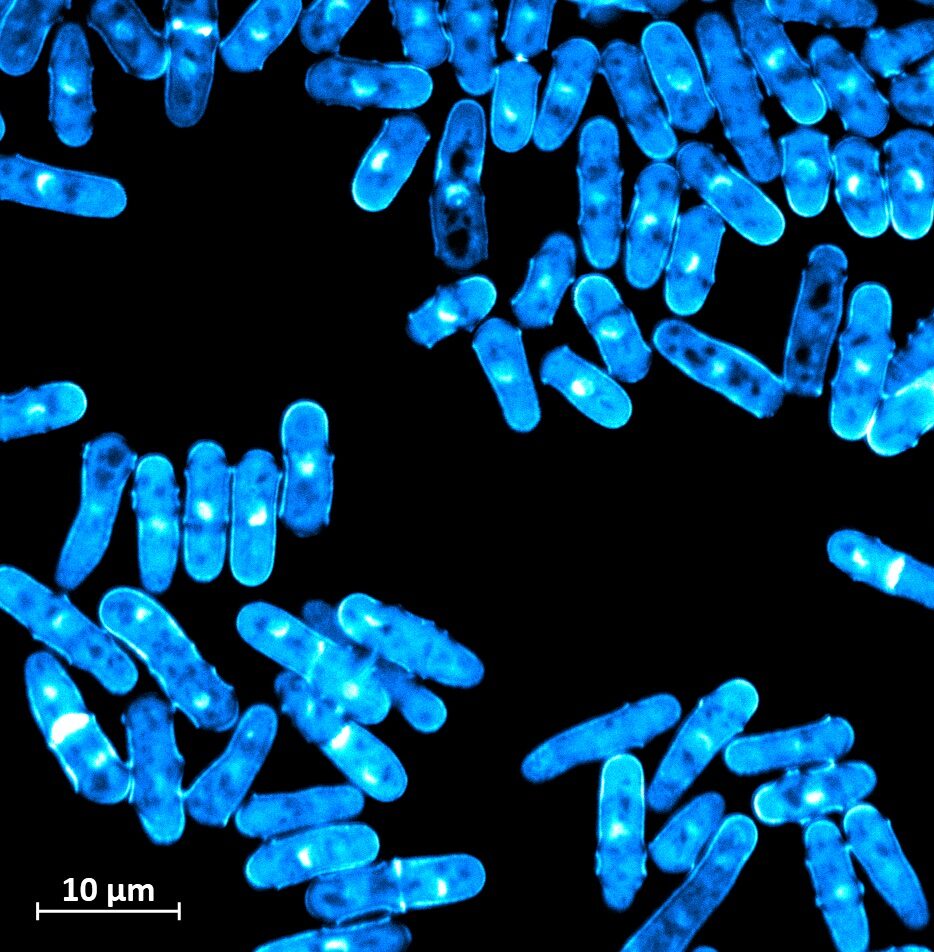
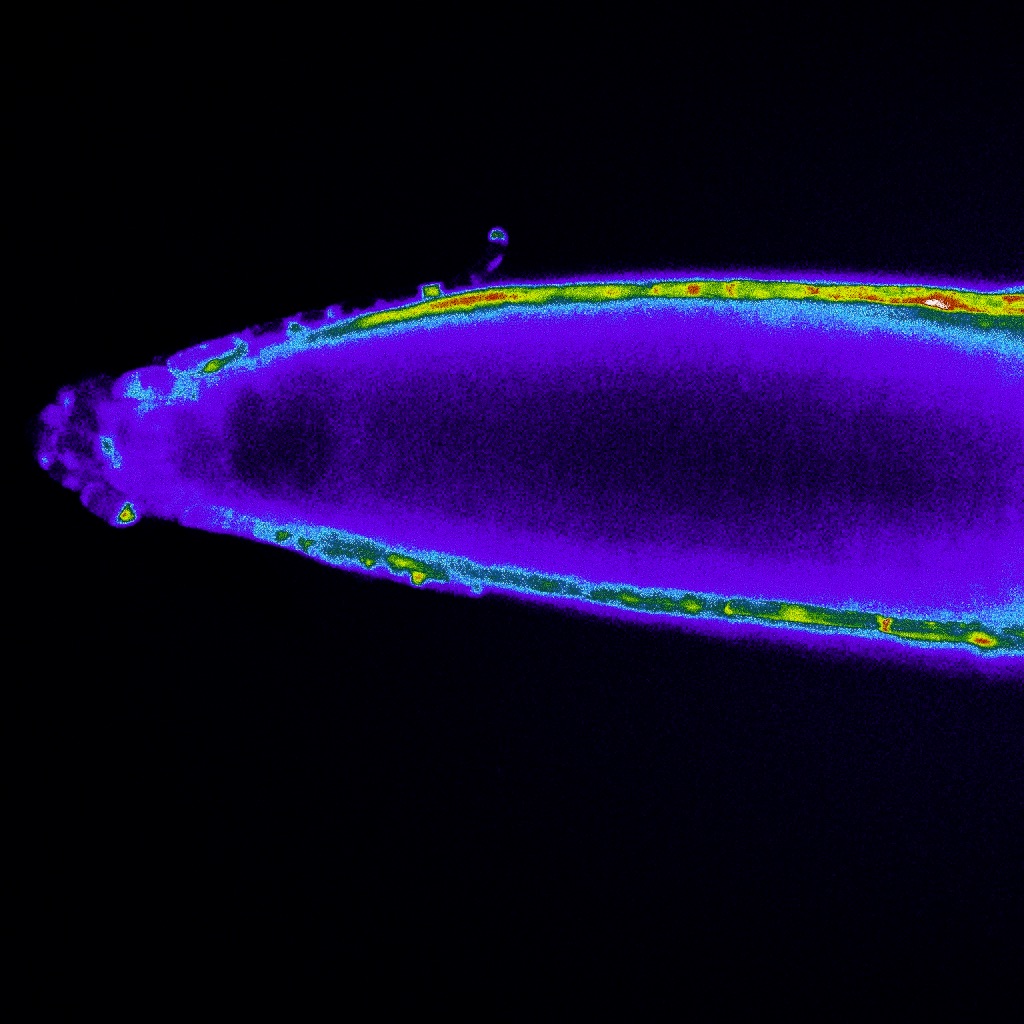
Top: Lateral Root Emergence {Gayomba Postdoc}
Center: S. pombe (yeast) cell walls {Huckabee BS’19}
Lower: ROS signaling in root tip {Sarkel BS’18}